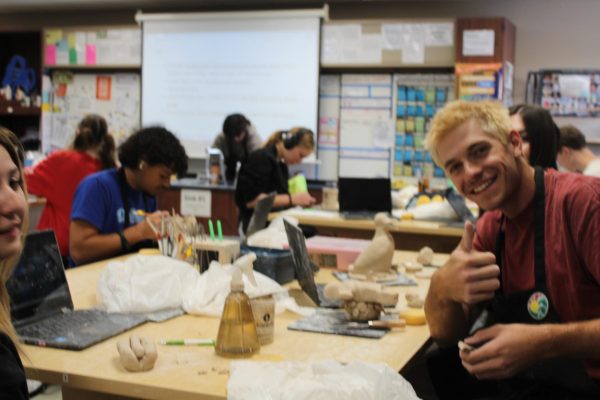
Every elective class has its pros and cons. Ceramics, with seemingly more pros than cons, is one of the more popular, allowing students to run wild with their imagination, creating without worry.
In art, foundational skills are required to create pieces. Ceramics teacher Mrs. Ridder explained the basic techniques of ceramics. First, there is “hand-building and throwing. There is coil, pinch, slab, hollowing; [a] combination of things” she said.
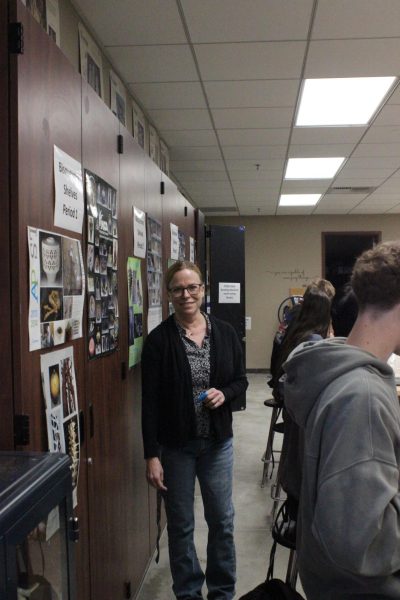
Hand-building is the process of cutting a block of clay to the necessary size and then “you use your hands and fingers to shape it” and create a rough outline of the desired shape, Mrs. Ridder shared. This provides the basis for the sculptor’s vision, so there is a guideline of what needs to be done.
Following the handbuilding process, clay is put onto a spinning wheel to begin “throwing.” While the wheel spins, the clay is molded with water into a cup, bowl, vase or other objects. This technique requires more skill than the others, as the watered-down clay could collapse if spun too fast or spin off the wheel entirely. Additionally, when the clay is on the wheel, it is hard to make objects because excessive molding thins the walls of the object and ruins it.
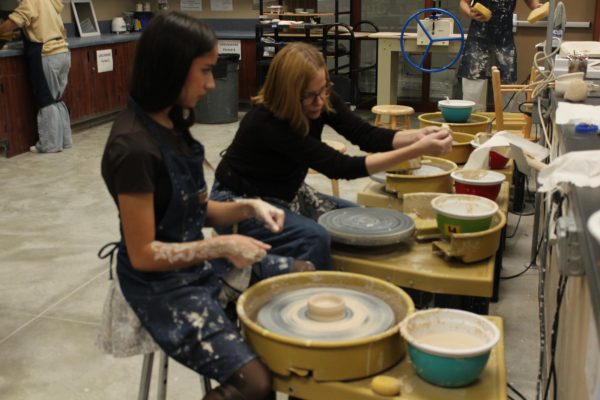
There are several ways to create a bowl or cup after hand-building, such as coil. To begin the coiling process, clay is cut and rolled into thin ropes and then wrapped around the desired shape.
The pinch technique is another route to making dinnerware after hand-building. “Pinch” is pinching the clay into a pot, or other dinnerware, such as plates and bowls. This leaves imprints on the object, making it look more handmade than other techniques.
Slab is when the clay is rolled into a thin slab and bent into a cylindrical shape. This allows for beginners to make bowls, cups and other dinnerware. It also ensures that the height and width of the dinnerware are evenly distributed, unlike other techniques. For example, in coil, the width of each rope could vary and throwing needs extreme skill to have the same width and height.
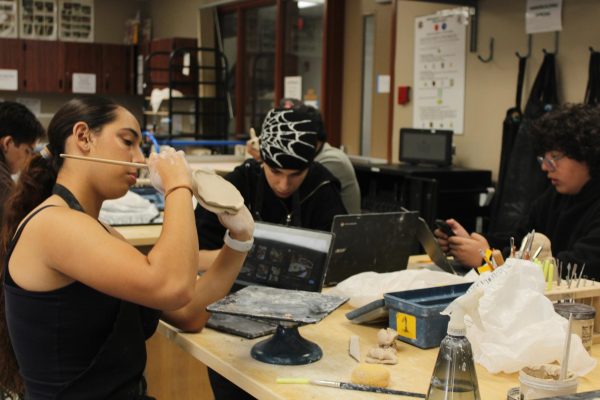
And finally, “hollowing” is when excess clay is removed from the inside of a solid sculpture, leaving it hollow or empty on the inside. This technique could help the sculpture dry in the kiln, or baking area, and potentially avoid the sculpture exploding in higher temperatures. Additionally, the hollowing technique includes piecing the sculpture back together using “slip and scores” which are little slash marks along the border or edge of the sculpture to put them back together by friction.
However, in practice, some techniques are more prevalent than others. Stana Holley, a Freshman of Mrs. Ridder says that in class they model the clay most of the time. Modeling clay is similar to hand-building: it is when the clay is shaped into a bowl or cup without any other techniques, such as coil, pinch, throwing or slab. Handbuilding is used more frequently as most students have more control over their object as they are modeling, compared to other techniques. In addition to modeling, Holley enjoys the glazing, or the painting, part of ceramics because “I like to see it come to life, with all the colors that I envisioned it to have.”
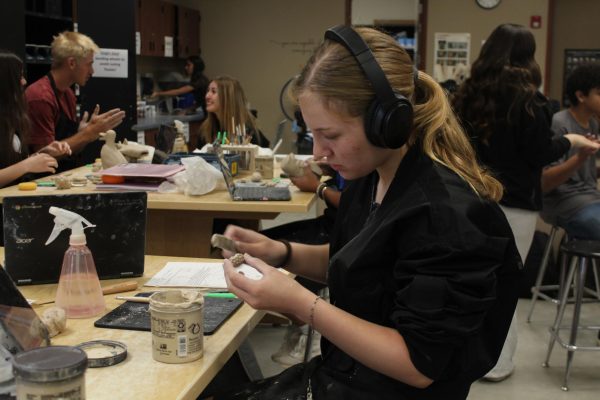
Beyond creating lasting projects, students are drawn to this elective as it emphasizes creative expression through functional art. Holley chose Ceramics mainly because she liked “the aspect of making whatever you want” and that Ceramics “really lets you take creative freedom.”
Harmony Ha-Lee, another Freshman of Mrs. Ridder finds “the medium very entertaining as opposed to the traditional artwork and visual art [because] it’s interesting how you can really work the clay with your hands [and overcome] different challenges.” Ha-Lee elaborates on one of the challenges she faced transitioning from 2D to 3D. When the shape changes to 3D, there is a different aspect of thinking, since 2D only provides the layers that make it up. However, with 3D, it also involves the shape staying upright.
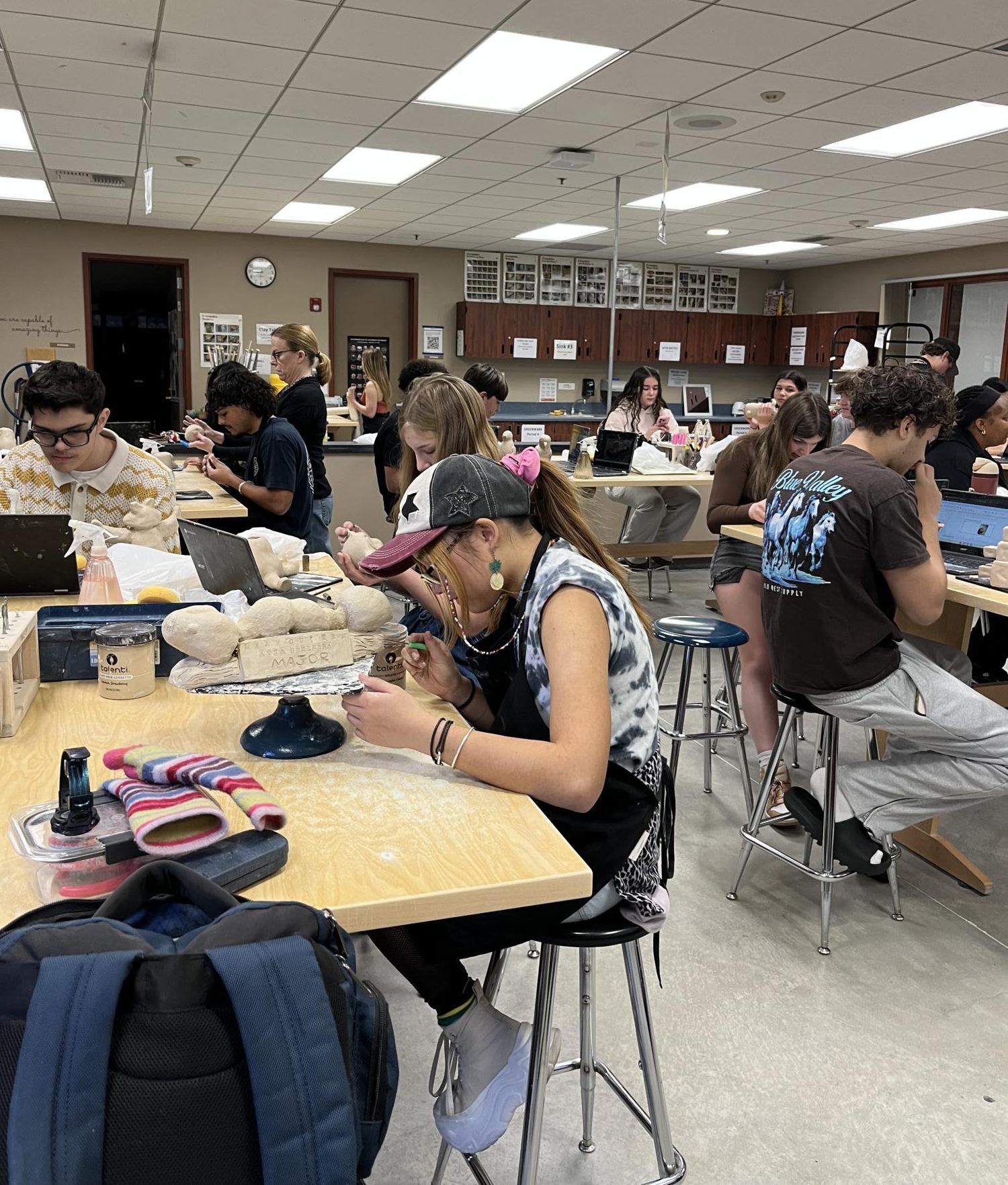
In addition to the elective’s artistic opportunities, it also teaches students important lessons that can be further utilized in the creative field. Holley explains that Ceramics can “teach you patience [and] help with precision to get better details and observation.” These skills will ultimately aid people in life and ceramics, where they can learn to wait and appreciate the things that take time, as well as know how to get through tough periods.
With Ceramics, there are a variety of different techniques and ways to create, from hand-building and modeling to coil, pinch, throwing or slab. All these different routes have their rules, but can also be combined to make something beautiful, making it the reason why students say that Ceramics is such a popular elective class.